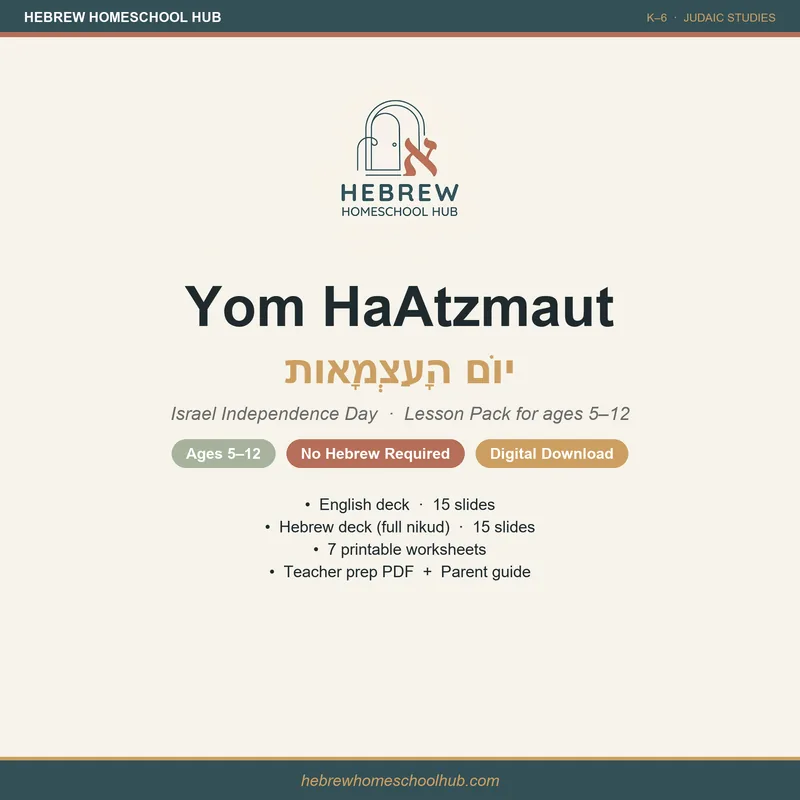
Yom HaAtzmaut יוֹם הָעַצְמָאוּת
The modern continuation of the Exodus — coming home to the land of Israel.
See the Yom HaAtzmaut pack →Spring nights, the Seder table, the Four Questions in a child's voice. 15 slides take your child through every part of the Seder, then gently tell the story of going out of Mitzrayim — no plague-scenes, no scary villains, just freedom and gratitude.
New: Free 30-minute lesson plan — teach Pesach this week, then grab the pack for the full version.


Download and extract the ZIP folder. Open the printable worksheets, guides and toolkit in a PDF reader. Use PowerPoint or compatible presentation software for the lesson decks and optional worksheet editing. Print holiday worksheets on US Letter paper.
Single-family license: print for your own household. Each family in a co-op needs its own copy. The toolkit paper sizes and worksheet formats are alternate editions, not additional unique pages.
Need help? Website buyers can email hebrewhomeschoolhub@gmail.com with their product and order details. Etsy buyers can contact the shop through their order messages.
Slide 7 of the Hebrew deck shows the Four Questions in full nikud — exactly what your youngest will ask at the Seder. The parent guide adds transliteration and pronunciation:
We open with the Seder — the order, the plate, the matzah, the questions — because that's what your child will actually experience at the table. Only after they know the rituals do we gently fill in the why: long ago in Mitzrayim, our family prayed, Hashem heard us, and we went out.
Every Hebrew word transliterated. Every speaker note in English. The parent guide has a pronunciation cheat sheet for every Hebrew word in the pack — including the full Mah Nishtana.
"We were not free, our family prayed, Hashem heard us, we went out." That's our framing. No plague imagery, no oppression scenes — just the going-out and the gratitude.
The parent guide includes a Seder-night reader — just a few slides per stage of the Seder, designed for a tired 5-year-old at 7pm. Most families teach the full lesson in the week before, then use this at the table.
We don't dwell on them. The story focuses on the family in Mitzrayim, the prayer, and the going-out. The plagues are referenced in context ("Hashem helped us leave") but never shown as scary scenes. Age-appropriate for K–6 (ages 5–12).
Yes — slide 7 of the Hebrew deck shows Mah Nishtana in full nikud. The English deck includes transliteration in the speaker notes so a parent who doesn't read Hebrew can still teach the youngest child to ask the question.
No. Every Hebrew word in the pack is transliterated, every speaker note is in English, and the parent guide includes a pronunciation cheat sheet for every Hebrew word you'll meet — Seder, Haggadah, matzah, Mah Nishtana, Dayenu, afikoman, Yetziat Mitzrayim.
Yes. The parent guide includes a "Seder-night reader" outline that uses just a few slides per stage of the Seder, designed for a tired 5-year-old at 7pm. Most families teach the full lesson in the week before Pesach, then use the shorter outline at the table.
Slide 8 introduces the afikoman as "the hidden matzah" — including the tradition of children searching for it and earning a prize. Worksheet page 6 is a coloring afikoman-hunt activity for kids who want to practice the tradition before the Seder.
Both names refer to the same holiday — פֶּסַח in Hebrew. We use "Pesach" throughout the lesson; you can use whichever name your family prefers when discussing it.
Pesach and Yom HaAtzmaut tell one long story — leaving Mitzrayim, then 3,000 years later coming home to the land of Israel. Buy them together and your child sees the whole arc.
The modern continuation of the Exodus — coming home to the land of Israel.
See the Yom HaAtzmaut pack →
Another story of religious freedom — the same theme, a different chapter of Jewish history.
See the Chanukah pack →Single ZIP download. Yours forever, free updates included. Single-family license. Buy and download instantly.
Diaspora observance. Every Pesach begins at sundown the evening before the first listed date. For halachic questions or Israel-observance dates, see our five-year Jewish calendar or consult your rabbi.
| Year | Begins | Halachic time span |
|---|---|---|
| 2026 | Wednesday | Begins Wednesday evening, Apr 1; ends Thursday night, Apr 9. (8 days) |
| 2027 | Wednesday | Begins Wednesday evening, Apr 21; ends Thursday night, Apr 29. (8 days) |
| 2028 | Monday | Begins Monday evening, Apr 10; ends Tuesday night, Apr 18. (8 days) |
| 2029 | Friday | Begins Friday evening, Mar 30; ends Saturday night, Apr 7. (8 days) |
| 2030 | Wednesday | Begins Wednesday evening, Apr 17; ends Thursday night, Apr 25. (8 days) |